Best Skin Treatments in Korea for Foreigners: Complete 2026 Guide
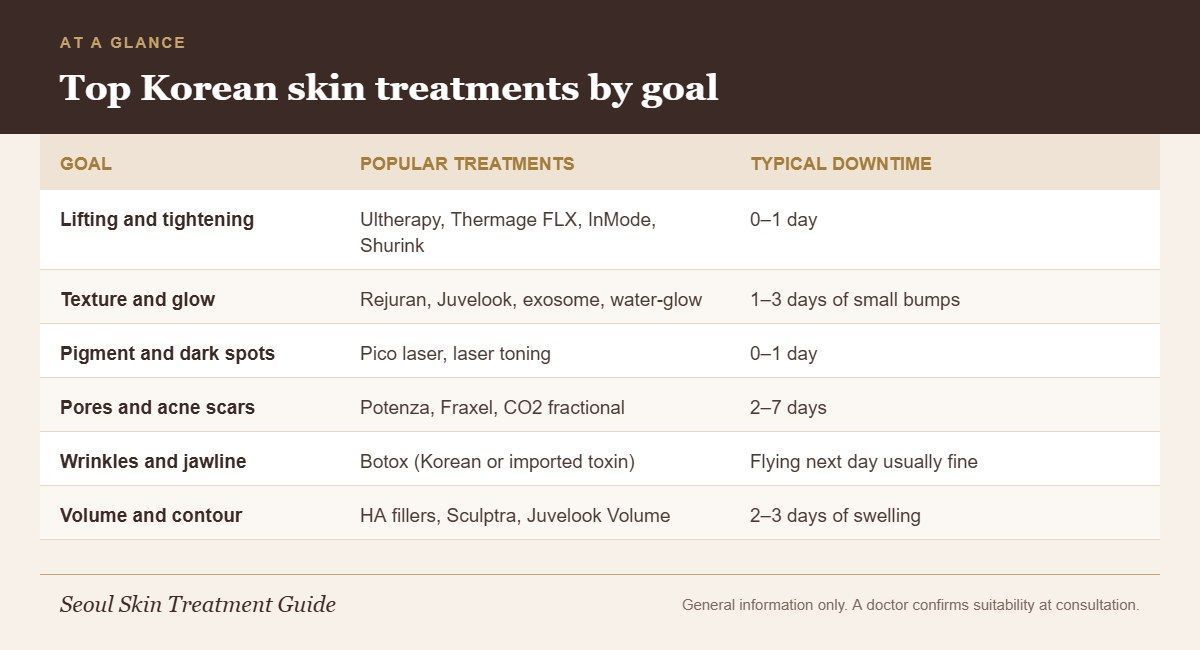
Quick answer: The best skin treatments in Korea for foreigners in 2026 are Ultherapy or Thermage FLX for lifting, Rejuran and Juvelook skin boosters for texture and glow, pico laser or laser toning for pigmentation, and Botox for wrinkles or jaw slimming. Most need little downtime, so they fit easily into a short Seoul trip.
Why do so many foreigners get skin treatments in Korea?
Seoul has one of the densest concentrations of dermatology clinics in the world. That competition keeps treatment menus wide and pricing transparent, and many clinics publish their price lists online. For visitors, the appeal is simple: you can access globally known devices and products such as Ultherapy, Thermage FLX, Juvederm and Restylane, often at a lower cost than at home, and many treatments take under an hour.
The second draw is Korean-developed treatments that are less common abroad, such as Rejuran (salmon-derived polynucleotides), Juvelook (a PDLLA collagen stimulator) and Potenza radiofrequency microneedling. These sit at the heart of the Korean approach to skin: improving skin quality gradually rather than changing your features. This guide walks through each category so you can decide what is worth booking before you land.
Which lifting treatments are the best in Korea?
Non-surgical lifting is the most requested category among English-speaking visitors because it usually needs a single session and almost no recovery. These are the four names you will see on every Seoul price list:
- Ultherapy is a micro-focused ultrasound treatment with real-time imaging that reaches the SMAS layer, the same layer tightened in a surgical facelift. Results build over 2–3 months and often last about a year or more. Learn more about Ultherapy in Seoul.
- Thermage FLX is a monopolar radiofrequency treatment that heats the dermis to tighten skin and refine texture, with a dedicated tip for the eye area. Results develop over 2–6 months and often last about 1–2 years. See Thermage FLX in Hongdae.
- InMode is a radiofrequency platform. In Korea, “InMode lifting” usually means Forma for tightening plus Mini FX or FX for small fat pockets under the chin and along the jawline, usually done as a series. Read about InMode lifting in Korea.
- Shurink Universe is a Korean HIFU device that is more affordable than Ultherapy and is often repeated more frequently. See Shurink Universe lifting.
Not sure which device fits your face? Our Thermage vs Ultherapy vs InMode comparison breaks down depth, sensation and cost side by side.
What are the best Korean skin boosters?
Skin boosters are injectables that improve skin quality, including hydration, elasticity and fine texture, rather than adding obvious volume. They are a signature of Korean dermatology and a big reason people search for the best skin treatments in Korea.
Rejuran Healer
Rejuran is a polynucleotide (PN) injectable derived from salmon DNA that supports skin repair, elasticity and texture. A typical plan is 3–4 sessions spaced 2–4 weeks apart, and small bumps usually settle within 24–48 hours. Rejuran HB contains lidocaine for comfort, and eye Rejuran targets thin under-eye skin. Details are on our Rejuran Healer page.
Juvelook and Juvelook Volume
Juvelook combines PDLLA with hyaluronic acid to stimulate collagen; Juvelook Volume has a higher PDLLA content for areas that need more support. Doctors usually suggest 2–3 sessions about 4 weeks apart. Compare options on the Juvelook in Korea page.
Exosome and water-glow boosters
Exosome treatments are usually applied with microneedling or laser to support recovery and skin quality; the evidence is still developing, so treat them as a supporting step. Water-glow hydrating boosters give a quicker dewy finish. Browse all skin boosters in Seoul.
Which laser treatments are popular in Seoul?
Korean clinics use lasers for three main jobs: clearing pigment, refining texture and resurfacing scars. The right choice depends on your skin type and how many days you can spare.
- Pico laser delivers picosecond pulses that break up pigment; pico toning targets spots and uneven tone, while pico fractional targets texture and scars. See pico laser in Korea.
- Laser toning uses low-fluence Q-switched Nd:YAG for gradual brightening over many sessions. It is common for melasma, which needs maintenance and has no permanent cure. Read about laser toning in Seoul.
- Potenza is a radiofrequency microneedling device for pores, acne scars and texture, with about 2–5 days of redness. It sits alongside classic microneedling in Korea.
- Fraxel and CO2 fractional resurface more deeply. CO2 means roughly 5–7 days of redness and crusting, so it suits the start of a longer stay.
Should you get Botox or fillers in Korea?
Botox is one of the easiest treatments to fit into a trip. Results appear in 3–7 days, peak at about 2 weeks and last 3–4 months, with jaw (masseter) Botox often lasting longer. Korean toxins such as Nabota and Botulax and imported options such as Allergan Botox and Xeomin are all widely used; imported toxins usually cost more. Find out more about Botox in Korea.
Hyaluronic acid fillers give an immediate result that lasts about 6–18 months depending on the area and product, and they can be dissolved with hyaluronidase if needed. Allow 2–3 days for swelling before photos or a long-haul flight. See dermal fillers in Seoul. If enlarged pores and oiliness are your main concern, ask about skin Botox (micro-Botox) at consultation.
How much do skin treatments cost in Korea in 2026?
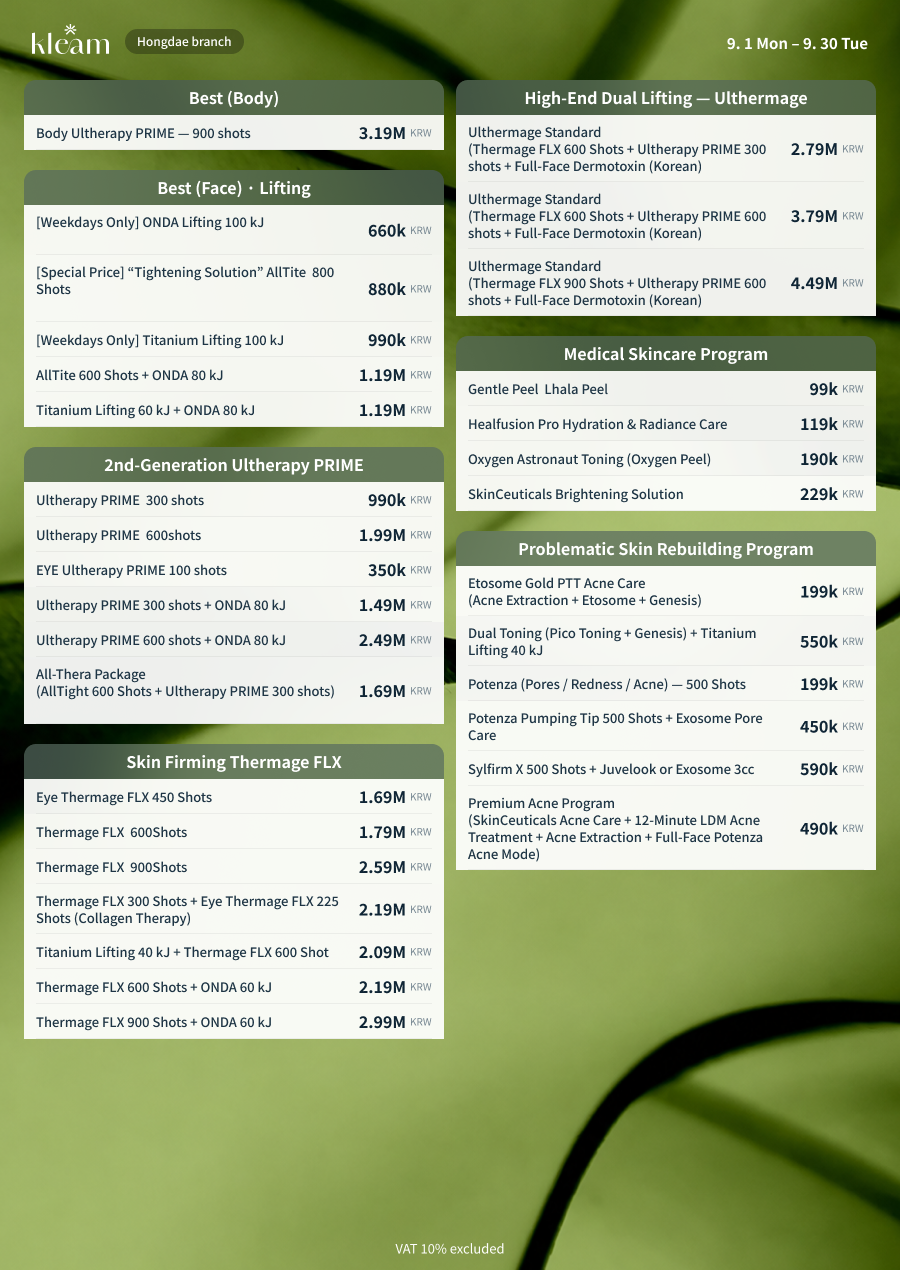
The table below shows approximate Seoul market ranges per session in 2026, converted at about KRW 1,400 per US dollar. They show what you are likely to see across the city.
| Treatment | Typical Seoul range (KRW) | Approx. USD |
|---|---|---|
| Ultherapy 300 lines | 800,000–1,800,000 | $570–1,290 |
| Thermage FLX 600 shots | 1,600,000–3,000,000 | $1,140–2,140 |
| InMode (Forma / FX) full face | 100,000–400,000 | $70–290 |
| Rejuran Healer 2cc | 200,000–450,000 | $140–320 |
| Juvelook Skin (1 session) | 250,000–500,000 | $180–360 |
| Pico toning | 50,000–150,000 | $35–110 |
| Botox forehead, Korean toxin | 30,000–100,000 | $20–70 |
| Filler per 1cc, imported | 250,000–500,000 | $180–360 |
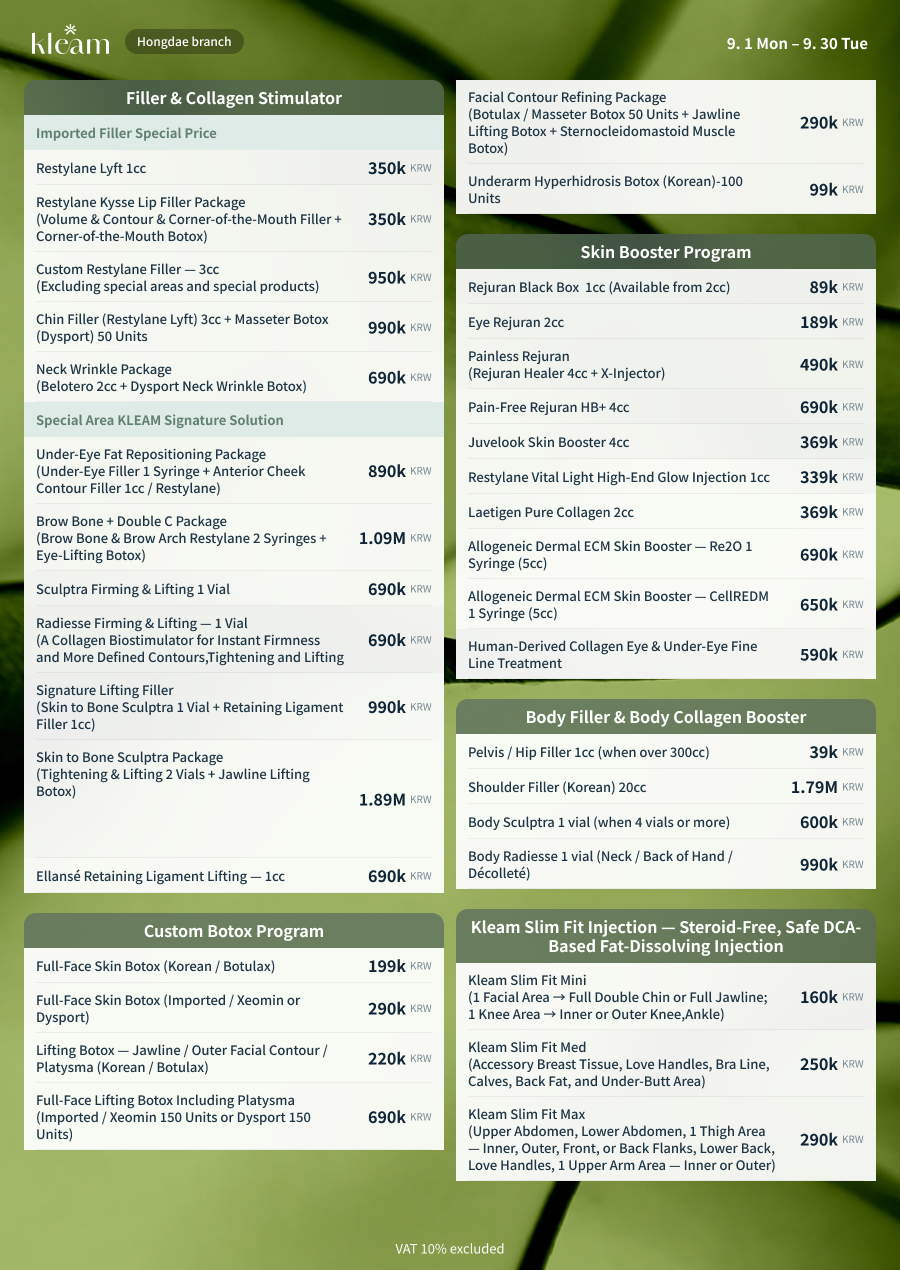
What moves the price: the number of lines, shots, units or cc; the device generation (for example Ultherapy Prime); genuine tips and products; whether a doctor performs the treatment; the area treated; the number of sessions or a package; whether numbing and aftercare are included; and the 10% VAT usually added to cosmetic procedures. For a full breakdown, read our skin clinic cost guide for Korea, and check the current price list at your clinic for exact figures.
How do you plan treatments around a short trip?
Use this checklist to build a realistic schedule:
- Book the consultation first. Send photos and goals by WhatsApp or KakaoTalk so the doctor can suggest a plan before you arrive.
- Put the longest downtime early. Potenza, Fraxel or CO2 belong at the start of your stay, not the end.
- Combine only what the doctor approves. Many clinics pair lifting with a booster or Botox in one visit, but the order and spacing matter.
- Leave a buffer before flights. Typically 0–1 day for lifting, laser toning and Botox, 2–3 days for fillers and 5–7 days for CO2.
- Protect your skin. Pack a broad-spectrum sunscreen and avoid saunas, heavy exercise and alcohol for 24–48 hours after injectables.
- Mention pregnancy or breastfeeding. Many treatments are postponed in these situations.
Planning your visit to a skin clinic in Hongdae, Seoul
Hongdae is an easy base for a short trip. Hongik Univ. Station is served by Subway Line 2, the Gyeongui–Jungang Line and the AREX Airport Railroad, which runs direct to Incheon and Gimpo airports, so you can fit treatments around arrival and departure days.
Before you book, ask whether English- or Japanese-speaking staff are available. Many clinics take consultations by WhatsApp or KakaoTalk, so send clear photos and your travel dates. Confirm who performs the treatment, the exact number of shots, units or cc, and whether 10% VAT is included. Compare quotes against the current Hongdae clinic price list, and leave a buffer before your flight. For broader planning, read about anti-aging treatments in Seoul, skin rejuvenation in Korea and treatments for dull skin.
Frequently asked questions
Can tourists get skin treatments in Korea?
Yes. Korean dermatology clinics routinely treat short-term visitors, and you usually only need your passport to register. The doctor reviews your skin, medical history and travel dates before recommending anything. Booking a consultation in advance by WhatsApp or KakaoTalk helps you secure a time slot and plan treatments around your flights.
Which Korean skin treatments have no downtime?
Ultherapy, Thermage FLX, InMode, Shurink, laser toning, pico toning and Botox usually involve 0–1 day of visible downtime, with mild redness at most. Skin boosters such as Rejuran and Juvelook leave small bumps for 1–3 days. Potenza and Fraxel need about 2–5 days, and CO2 fractional about 5–7 days.
Do Korean skin treatments hurt?
Most treatments feel like heat, snapping or brief stinging. Clinics in Seoul commonly apply numbing cream before lasers, boosters and lifting, and some products such as Rejuran HB contain lidocaine. Ultherapy is usually the most noticeable, especially over bony areas. Tell the doctor about your pain tolerance so the plan and numbing can be adjusted.
Can I fly home right after treatment?
After Botox, lifting devices and toning lasers, flying the next day is typically fine. For fillers, allow 2–3 days for swelling; for Potenza or Fraxel, 2–5 days; for CO2 fractional, 5–7 days. Avoid massage and saunas for 24–48 hours after injectables, and keep sunscreen handy on the plane.
How many sessions will I need?
Lifting such as Ultherapy or Thermage FLX is usually one session. Rejuran is typically 3–4 sessions and Juvelook 2–3 sessions about 4 weeks apart. Pigmentation lasers often need many sessions. The doctor confirms the number at consultation, and results vary from person to person.
Related guides
This guide is general information for international visitors, not medical advice. A doctor confirms suitability, dosage and number of sessions at consultation. Prices are approximate Seoul market ranges and change over time — always check the clinic's current price list. Last updated: October 2026.