What Skin Treatments Should You Get in Korea? A Foreigner’s Guide
Quick answer: The skin treatments you should get in Korea depend on your main concern, your age and how many days you have. For sagging, choose Ultherapy or Thermage FLX; for dull or rough skin, Rejuran or Juvelook; for dark spots, pico laser or laser toning; for wrinkles or jaw slimming, Botox. Leave higher-downtime lasers for longer stays.
How do you decide what skin treatments to get in Korea?
Seoul clinic menus can list more than 50 treatments, which makes choosing hard for foreigners. The simplest way to narrow it down is to answer three questions in order:
- What bothers you most? Sagging, wrinkles, dullness, pigmentation, acne, scars, pores or redness.
- How many days do you have after treatment? This rules options in or out faster than anything else.
- Is this a one-off or a series? Some treatments deliver in one session; others need 3–10 visits.
Budget comes fourth, because in Korea most concerns have both an affordable and a premium option. Once you know your answers, the decision usually becomes obvious.
Which treatments match your main skin concern?
This table maps common concerns to the treatments Korean clinics typically use. It is a starting point for your consultation, not a prescription.
| Concern | Common Korean treatments | Typical sessions | Typical downtime |
|---|---|---|---|
| Sagging, jawline | Ultherapy, Thermage FLX, InMode, Shurink | 1 (InMode and Shurink often repeated) | 0–1 day |
| Expression lines | Botox or Xeomin | 1, repeat every 3–4 months | Minimal |
| Dullness, rough texture | Rejuran, Juvelook, water-glow boosters | 2–4 | 1–3 days of bumps |
| Dark spots, freckles | Pico laser, laser toning, IPL | 1–10 depending on spot type | 0–1 day (spot laser can crust) |
| Melasma | Laser toning, pico toning | Many, plus maintenance | 0–1 day |
| Acne scars, pores | Potenza, Fraxel, CO2 fractional, pico fractional | 3–5 | 2–7 days |
| Redness | Vbeam, IPL | 2–5 | 0–2 days |
For sagging, start with Ultherapy in Korea or Thermage FLX in Seoul. For melasma, read our melasma treatment page first, because IPL can worsen melasma in some people. For redness, see Vbeam in Korea, and for scars, acne scar removal in Seoul.
What skin treatments suit your age?
Age is not a rule, but it is a useful guide to what most people prioritize.
In your 20s
The focus is usually acne, pores, oiliness and early pigmentation. Acne care, laser toning, pico toning and peels are common. If oiliness and pores bother you, ask about skin Botox (micro-Botox) at consultation.
In your 30s
Skin quality and early lines take center stage. Rejuran, Juvelook and water-glow boosters, preventive Botox and lighter lifting such as InMode or Shurink are popular choices.
In your 40s and beyond
Lifting and volume become the priority. Ultherapy or Thermage FLX tighten, while collagen stimulators such as Sculptra or Juvelook Volume restore gradual volume, and hyaluronic acid fillers give immediate support. See our wrinkle treatments in Korea for options.
What can you fit into your trip?
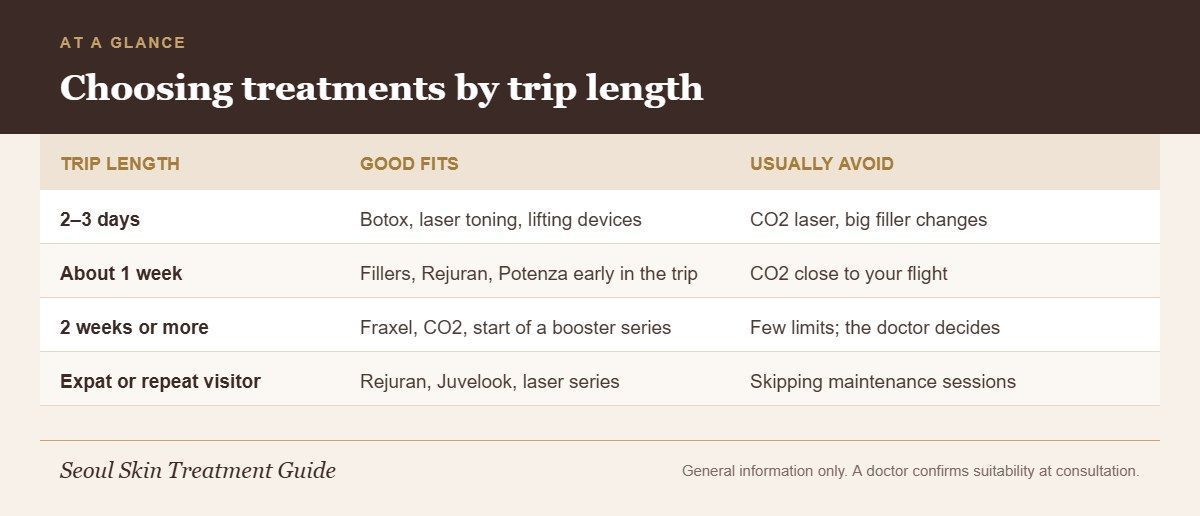
Your schedule decides what is realistic. Based on typical recovery times:
- 2–3 days: Botox, laser toning, pico toning and lifting devices are ideal; flying the next day is typically fine. Our short-trip treatment guide for Seoul lists more options.
- About a week: add fillers (allow 2–3 days for swelling), a first Rejuran session (bumps for 1–2 days) or Potenza early in the trip (2–5 days of redness).
- Two weeks or more: Fraxel and CO2 fractional become possible; CO2 needs roughly 5–7 days of redness and crusting.
- Expats and frequent visitors: you can follow a full series, such as 3–4 Rejuran sessions 2–4 weeks apart or regular laser toning for melasma.
Not sure how much buffer to leave? Read how long to stay in Korea after a skin treatment.
What should you get on different budgets?
Approximate Seoul market ranges in 2026 help you plan:
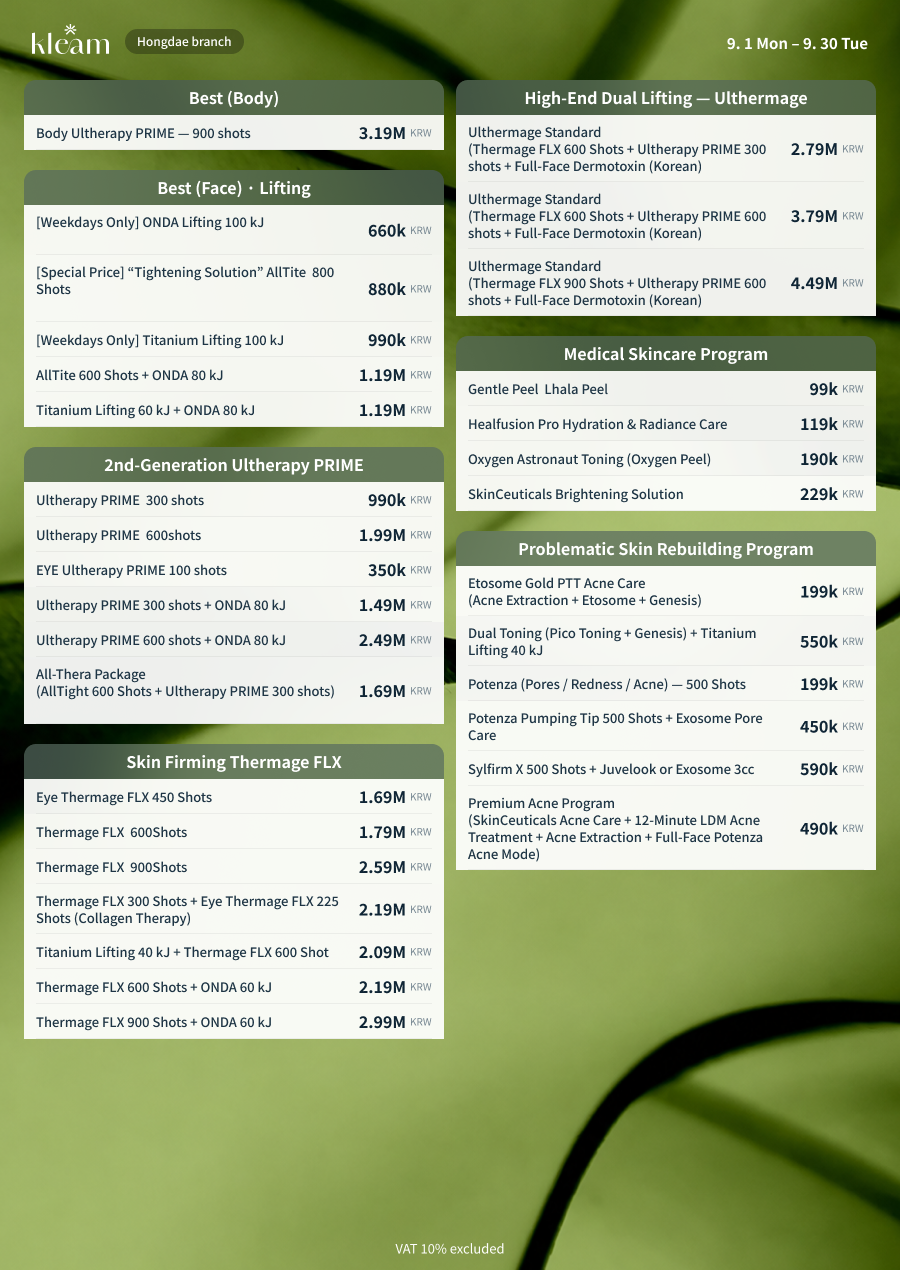
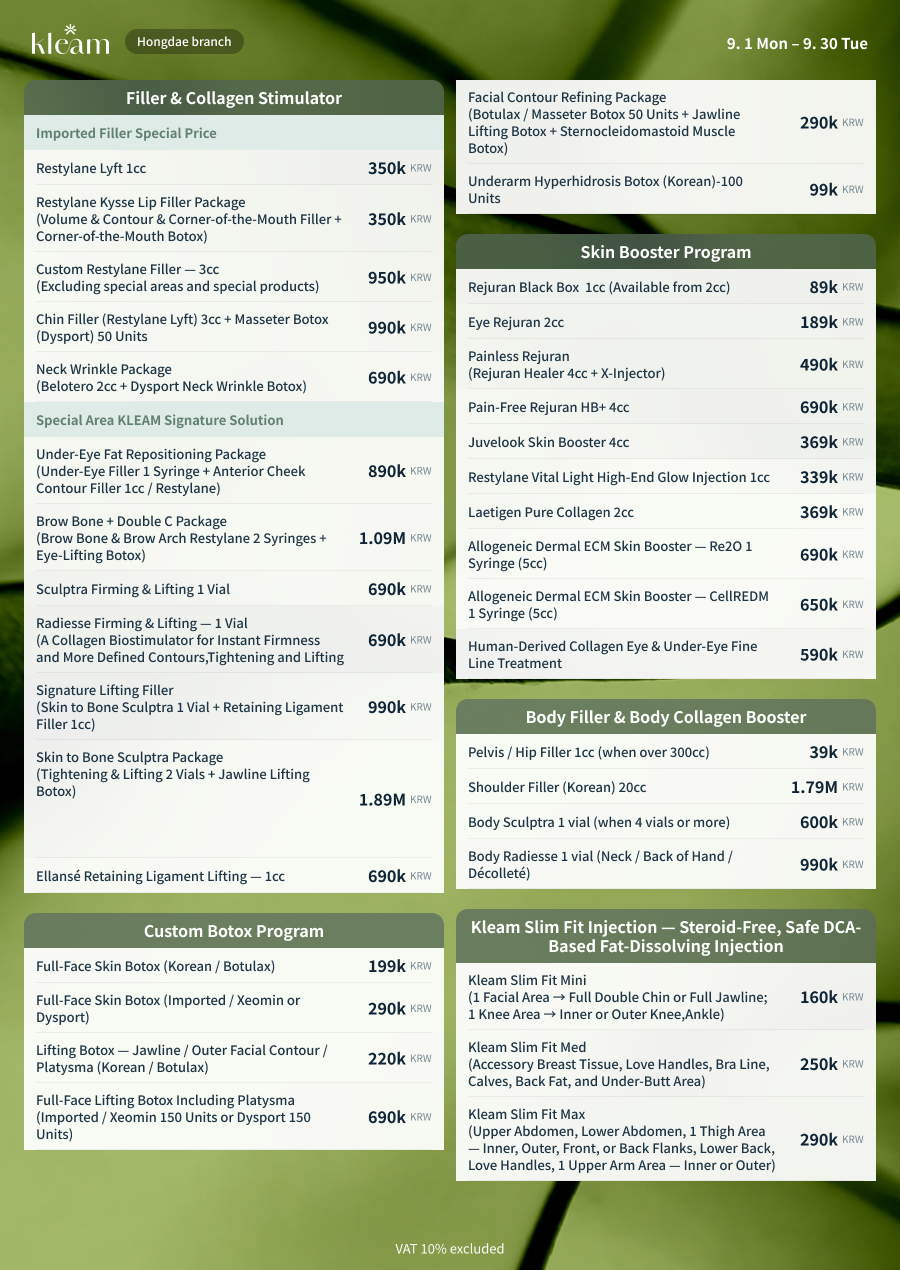
- Under about KRW 150,000 (US$110): laser toning (KRW 30,000–100,000), Aqua peel (KRW 30,000–80,000), Korean-toxin forehead Botox (KRW 30,000–100,000) or an acne care session (KRW 50,000–150,000).
- About KRW 150,000–500,000 (US$110–360): Rejuran Healer 2cc (KRW 200,000–450,000), Potenza (KRW 200,000–500,000), InMode full face (KRW 100,000–400,000) or Juvelook Skin (KRW 250,000–500,000).
- Above KRW 800,000 (US$570): Ultherapy 300 lines (KRW 800,000–1,800,000) or Thermage FLX 600 shots (KRW 1,600,000–3,000,000).
Prices vary with lines, shots, units or cc, the product brand, doctor involvement, packages and the 10% VAT usually added. Compare with the current price list.
Which treatments should you skip on a short trip?
Some treatments are better left for a longer visit or for home. Ablative CO2 resurfacing right before a flight, a large first-time filler change you cannot review, or starting a series you cannot continue can all leave you with less benefit than expected. If you can only do one session of a series treatment, ask the doctor whether a single session still makes sense for your goal.
Planning your visit to a skin clinic in Hongdae, Seoul
Hongdae is a convenient base for a short trip. Hongik Univ. Station is on Subway Line 2 and the Gyeongui–Jungang Line, and AREX trains run direct to Incheon and Gimpo airports, so you can schedule treatments around arrival or departure day.
Ask for English- or Japanese-speaking staff, and look for clinics that arrange consultations by WhatsApp or KakaoTalk. Send photos and your travel dates, then confirm who performs the treatment, the exact shots, units or cc, and whether VAT is included. Check the current Hongdae clinic price list, leave a buffer before flights, and browse pico laser in Hongdae and Rejuran Healer in Seoul if pigment or skin quality is your goal. Bring your passport and a list of any medications or skincare products you use, and ask for written aftercare instructions before you leave.
Frequently asked questions
What is the most popular skin treatment in Korea for foreigners?
Lifting devices such as Ultherapy and Thermage FLX, skin boosters such as Rejuran, laser toning and Botox are among the most requested. They are popular because they need little downtime and fit a short trip. The right one for you depends on your concern, skin type and the doctor's assessment.
Should I get one big treatment or several small ones?
It depends on your goal. One lifting session can address sagging, while texture and pigmentation often respond better to a combination, such as toning plus a booster. A doctor can tell you which combinations are safe on the same day and which should be spaced out.
Is a single session of Rejuran or laser toning worth it?
A single session can give a modest improvement, but Rejuran usually works best as 3–4 sessions 2–4 weeks apart, and laser toning as a longer series. If you visit Korea only once, ask whether a one-session alternative, such as a lifting device or Botox, better fits your goal.
How much should I budget for treatments in Seoul?
Simple treatments start around KRW 30,000–100,000 (roughly US$20–70), while premium lifting such as Ultherapy 300 lines is typically KRW 800,000–1,800,000 (roughly US$570–1,290). Add 10% VAT where applicable and check whether numbing and aftercare are included.
Can I get treatments if I have sensitive skin?
Usually, yes, with adjustments. Doctors may lower laser settings, choose gentler peels or recommend repair-focused boosters such as Rejuran. Mention any rosacea, eczema or reactions to past treatments at consultation. Strong peels and aggressive resurfacing may not be suitable right away.
Related guides
This guide is general information for international visitors, not medical advice. A doctor confirms suitability, dosage and number of sessions at consultation. Prices are approximate Seoul market ranges and change over time — always check the clinic's current price list. Last updated: October 2026.