How Long Should You Stay in Korea After a Skin Treatment?
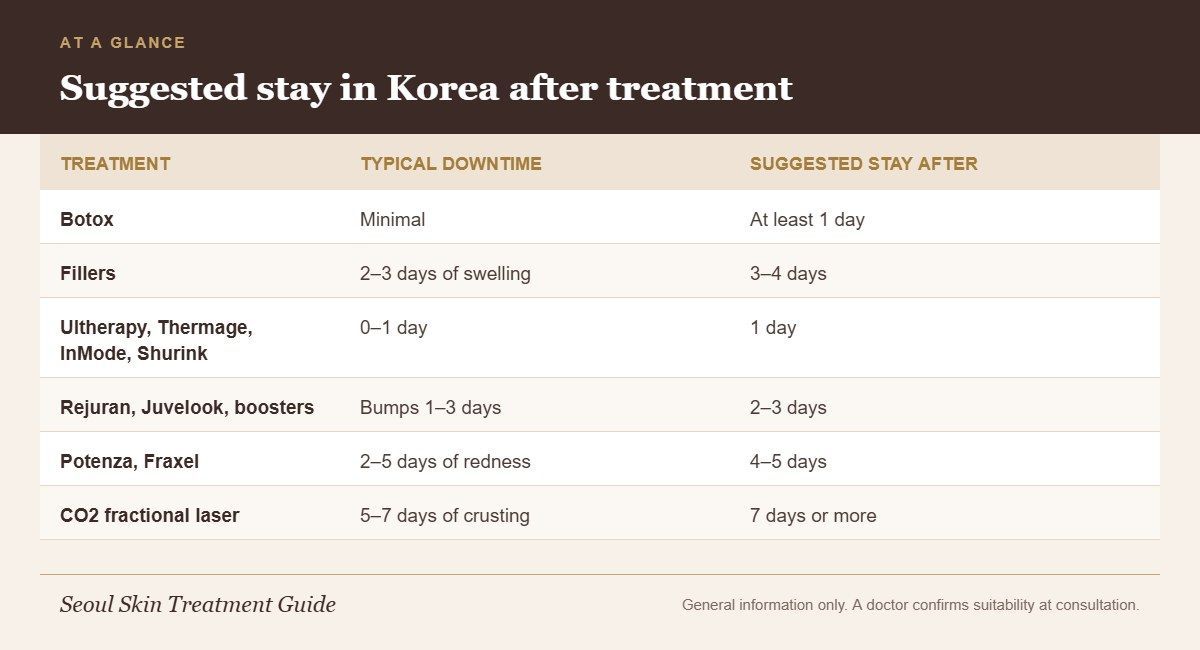
Quick answer: How long you should stay in Korea after a skin treatment depends on its downtime. Plan at least 1 day after Botox, lifting devices like Ultherapy or InMode, and laser toning; 2–3 days after skin boosters; 3–4 days after fillers; 4–5 days after Potenza or Fraxel; and about a week after CO2 laser. Add one buffer day if possible.
Why does the length of your stay after treatment matter?
Most skin treatments in Seoul are quick, but recovery happens over the following days. Staying in Korea long enough lets you get through the visible downtime, follow aftercare in a calm setting, and return to the clinic if something needs checking. That last point is the one foreigners most often overlook.
If you leave the day after a filler and notice asymmetry or unusual swelling at home, the clinic can only advise you remotely. If you stay a few more days, a doctor can look in person. So when you ask how long to stay in Korea after a skin treatment, think of two things: downtime and a follow-up window.
How long should you stay after each type of treatment?
| Treatment | What recovery looks like | Suggested stay after |
|---|---|---|
| Botox | Tiny marks for hours; results in 3–7 days | 1 day minimum |
| Fillers | Swelling and possible bruising for 2–3 days | 3–4 days |
| Lifting devices | Mild redness or tenderness, 0–1 day | 1 day |
| Skin boosters | Small bumps 1–3 days | 2–3 days |
| Pico or laser toning | Mild redness, 0–1 day | 1 day |
| Potenza or Fraxel | Redness, roughness 2–5 days | 4–5 days |
| CO2 fractional | Redness and crusting 5–7 days | About 7 days |
These are typical guidelines. Your doctor may recommend more time based on your skin, the area and the intensity of the treatment.
Injectables: how long after Botox, fillers and boosters?
Botox
Botox in Korea has almost no visible downtime, and flying the next day is usually fine. Results start in 3–7 days and peak at about 2 weeks, so you will likely see the final effect at home. Avoid massage, saunas and lying face-down for 24–48 hours. If you want a touch-up check, a 2-week stay is ideal but rarely practical; sending photos to the clinic is the common alternative.
Fillers
With dermal fillers in Seoul, swelling usually settles over 2–3 days, and lips can swell more. Staying 3–4 days lets you see the shape more clearly and return if you have concerns. Hyaluronic acid filler can be adjusted or dissolved with hyaluronidase, which is easier to arrange while you are still in Seoul.
Skin boosters
Rejuran Healer, Juvelook and hydrating boosters leave small bumps for 24–48 hours, sometimes up to 3 days. Two to three days is enough for most people. Remember that these are series treatments: Rejuran is typically 3–4 sessions 2–4 weeks apart, so on a short trip you are doing one session of a plan.
Lasers and lifting: how long should you stay?
Energy-based lifting has very little downtime. After Thermage FLX, Ultherapy, InMode or Shurink, most people look normal within hours to a day, with occasional tenderness along the jaw. One extra day is usually plenty. Results build over 2–3 months (Thermage up to about 6), so there is nothing to wait for in Seoul.
Lasers vary more. Pico laser and toning cause mild redness for hours to a day. Resurfacing is different:
- Potenza (radiofrequency microneedling, see microneedling in Seoul): about 2–5 days of redness.
- Fraxel: non-ablative, about 2–5 days of redness and dryness.
- CO2 fractional laser: ablative, about 5–7 days of redness and crusting, with strict sun protection afterwards.
For acne scar plans that use these, a stay of a week or more makes sense.
How should you plan treatments across your trip?
- Book the highest-downtime treatment first , ideally on day 1 or 2 of your trip.
- Schedule low-downtime extras later , such as Botox or toning.
- Keep the last day free of new procedures, especially fillers and resurfacing lasers.
- Plan a follow-up slot 2–4 days after injectables if your stay allows.
- Choose events and photos with care : avoid weddings, interviews or photo shoots within the downtime window.
If you only have 2–3 days, focus on the options in our short trip to Seoul guide and Korean dermatology treatments with little or no downtime.
Does staying longer change the cost?
Treatment cost does not depend on how long you stay, but your plan might. Higher-downtime treatments are often worth doing only on longer trips. Typical Seoul ranges in 2026 (approximate):
- Fraxel: about KRW 150,000–400,000 (roughly US$107–286) per session.
- CO2 fractional: about KRW 100,000–300,000 (roughly US$71–214).
- Potenza: about KRW 200,000–500,000 (roughly US$143–357).
- Korean filler per 1cc: about KRW 100,000–250,000 (roughly US$71–179).
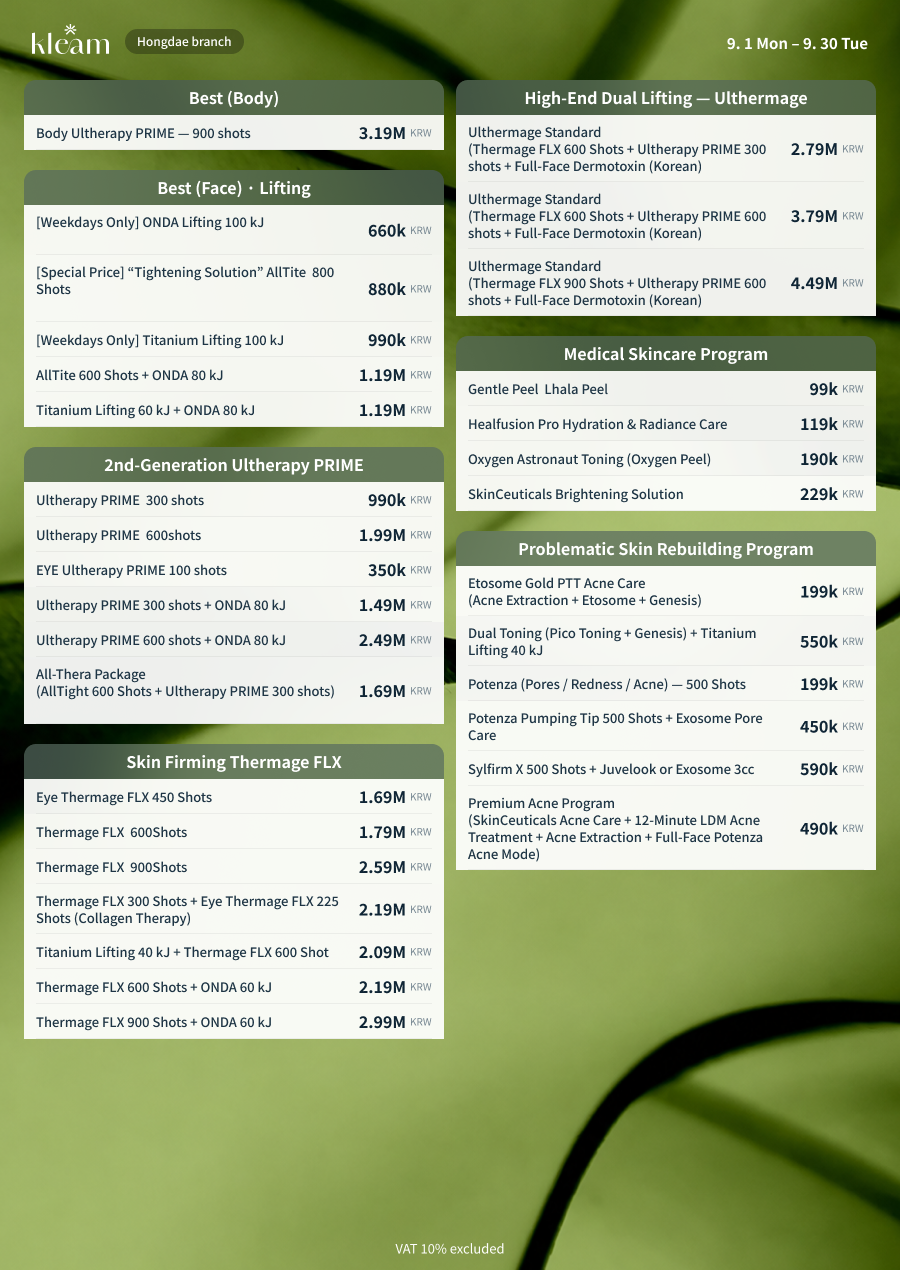
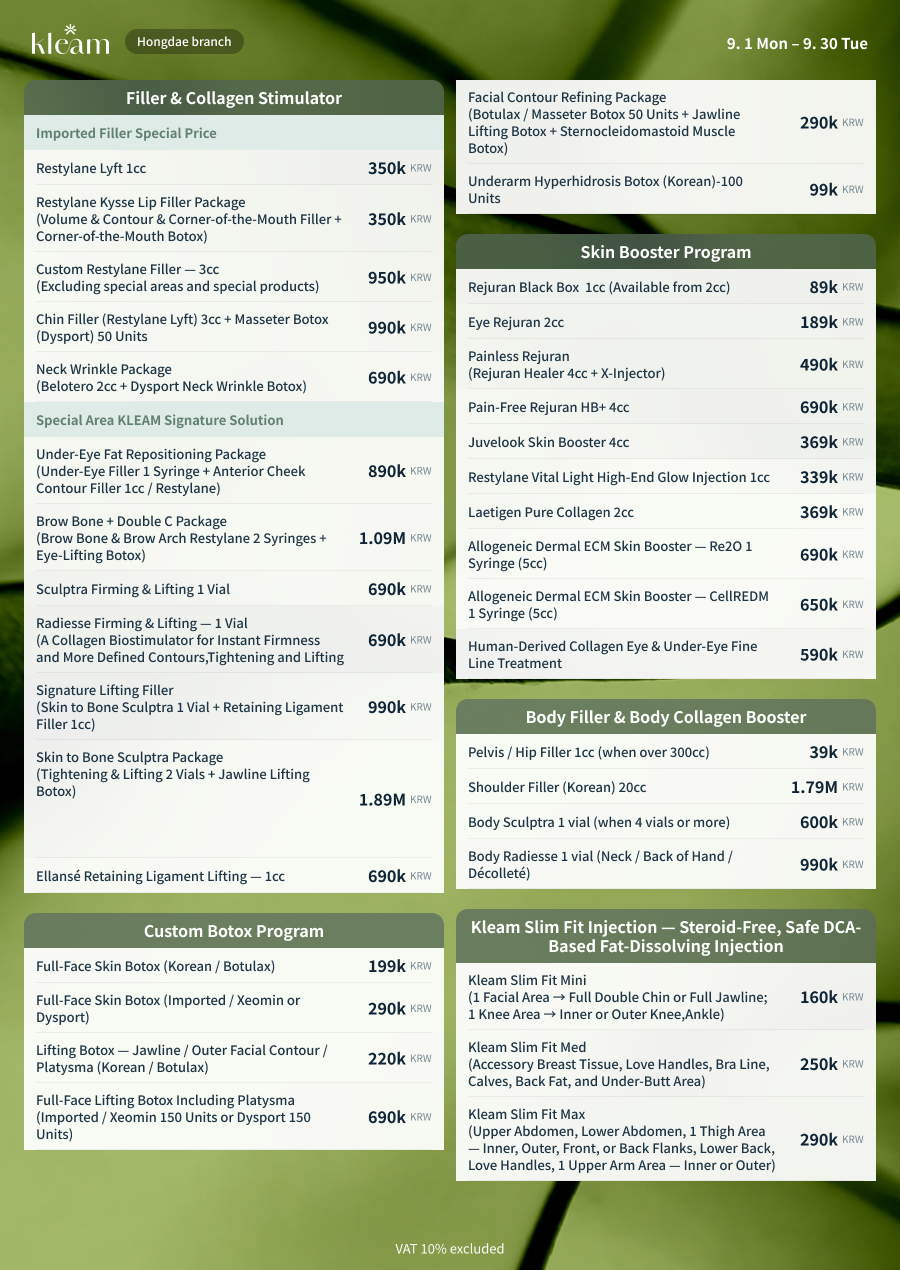
Session count, area, device and product all affect the final price, and 10% VAT is often added. For up-to-date figures, see the current price list.
Planning your visit to a skin clinic in Hongdae, Seoul
Hongik Univ. Station in Hongdae is on Line 2, the Gyeongui–Jungang Line and the AREX Airport Railroad, with direct trains to Incheon and Gimpo airports. Hongdae also has many hotels and guesthouses, so it is easy to stay nearby during recovery.
- Language: ask for English- or Japanese-speaking staff.
- Consultation: many clinics take messages by WhatsApp or KakaoTalk. Send photos plus your arrival and departure dates so the plan fits your stay.
- Confirm details: who performs the treatment, the exact shots, units or cc, and whether VAT is included.
- Prices: check the current Hongdae clinic price list and ask about low-downtime options such as chemical peels or skin boosters.
Leave a buffer before your flight and keep a follow-up slot if your stay allows.
Frequently asked questions
Can I get a treatment on the day I arrive in Korea?
Yes, many visitors do. Arrival-day treatments give you the most recovery time before your flight home. If you land at Incheon or Gimpo, AREX to Hongik Univ. Station makes a same-day visit practical. Just be aware that long flights can leave skin dry and you may be tired, so consider gentle options first.
Is one day enough after Botox before flying?
Usually yes. Botox has minimal downtime, and flying the next day is generally fine. Avoid pressing or massaging treated areas and skip saunas for 24–48 hours. Results build over 3–7 days and peak at about 2 weeks, so you will see the full effect at home.
What if I only have a weekend in Seoul?
Choose low-downtime treatments such as Botox, laser toning, pico toning, InMode, Shurink, Ultherapy or Thermage. Hydrating boosters can work if you accept 1–2 days of small bumps. Save fillers in visible areas, Potenza, Fraxel and CO2 laser for longer trips.
Should I stay longer for fillers than for skin boosters?
Generally yes. Filler swelling takes about 2–3 days to settle and the shape is easier to judge afterwards, so 3–4 days is a comfortable stay. Skin boosters mainly cause small bumps for 1–3 days. In both cases, staying lets the clinic check you in person if needed.
What if I notice a problem after flying home?
Message the clinic with clear photos and a description; many can advise remotely. Keep a record of the treatment, product and date for your local doctor. For severe pain, skin color change near an injection or vision changes, seek urgent local medical care immediately.
Related guides
This guide is general information for international visitors, not medical advice. A doctor confirms suitability, dosage and number of sessions at consultation. Prices are approximate Seoul market ranges and change over time — always check the clinic's current price list. Last updated: October 2026.