Dermal Filler Cost in Korea: 2026 Price Guide
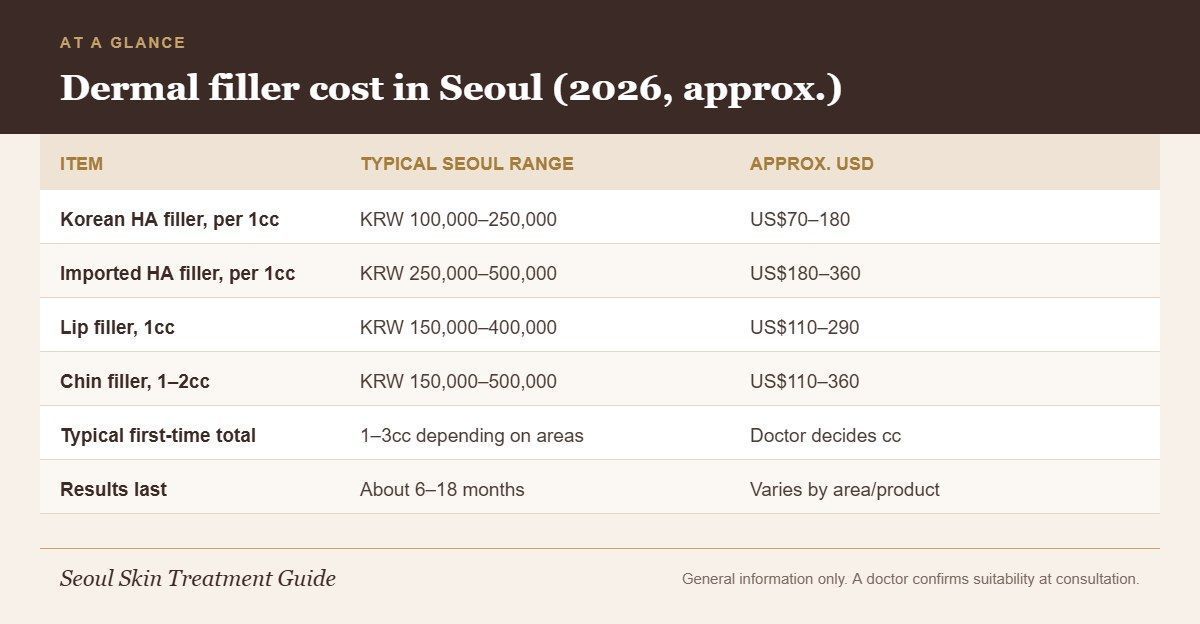
Quick answer: Dermal filler cost in Korea is usually charged per cc. In Seoul in 2026, Korean hyaluronic acid (HA) fillers typically cost about KRW 100,000–250,000 (US$70–180) per 1cc, while imported brands such as Juvederm, Restylane and Belotero run about KRW 250,000–500,000 (US$180–360) per cc. Your total depends on how many cc and which areas you treat.
How much does dermal filler cost in Korea in 2026?
Dermal filler is a gel injected under the skin to restore volume, smooth folds or refine contours. Most fillers used in Korea are hyaluronic acid (HA), a sugar molecule your skin makes naturally, which is why results are immediate and can be reversed with an enzyme if needed.
In Seoul, the typical 2026 market ranges look like this (approximate, per session, before any promotions):
| Filler type or area | Typical Seoul range (KRW) | Approx. USD | Usual amount |
|---|---|---|---|
| Korean HA filler (per 1cc) | 100,000–250,000 | US$70–180 | Any area |
| Imported HA filler (per 1cc) | 250,000–500,000 | US$180–360 | Any area |
| Lips | 150,000–400,000 | US$110–290 | 0.5–1cc |
| Chin | 150,000–500,000 | US$110–360 | 1–2cc |
| Nasolabial folds, temples, cheeks, nose | Per-cc price x cc used | Depends on cc | Often 1–2cc per area |
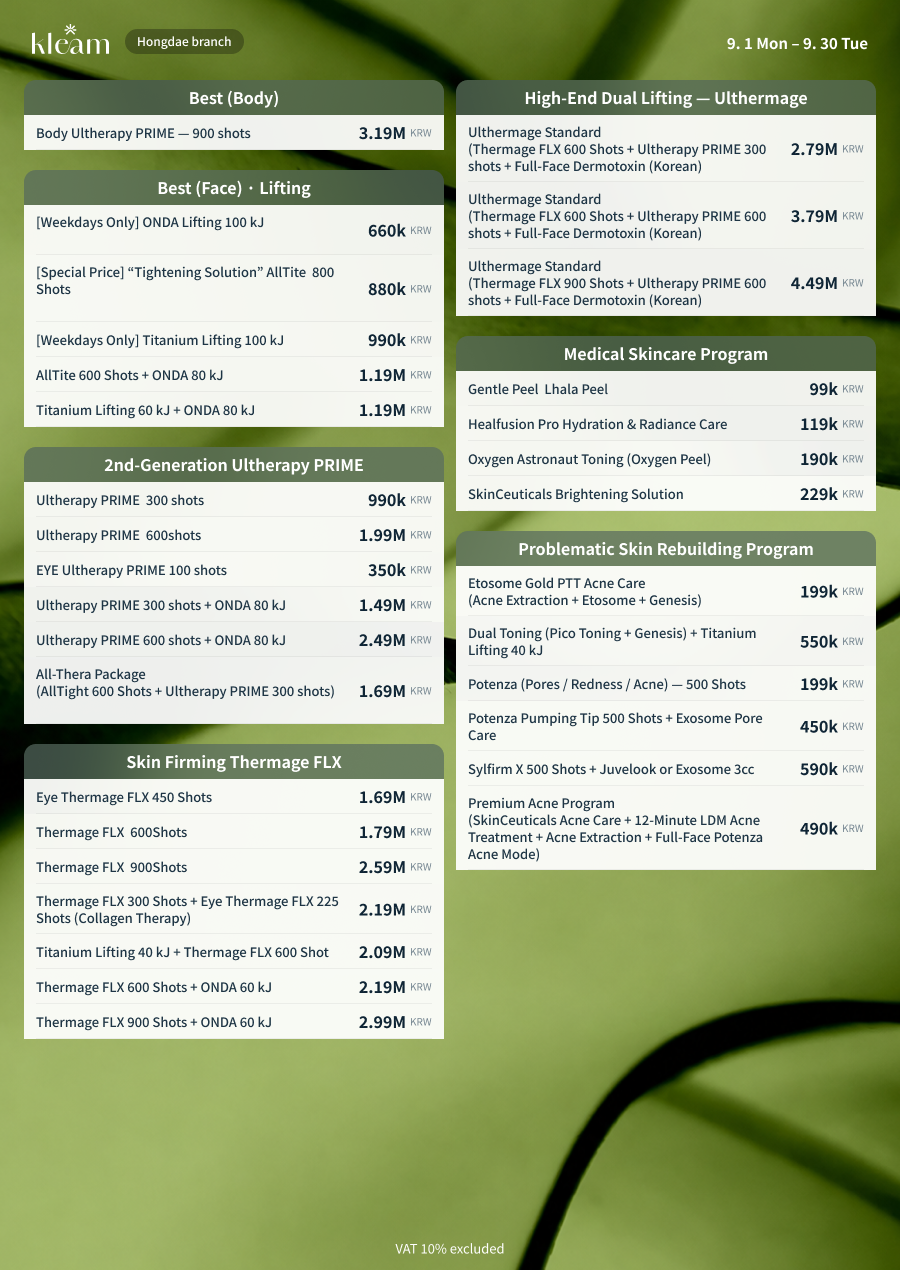
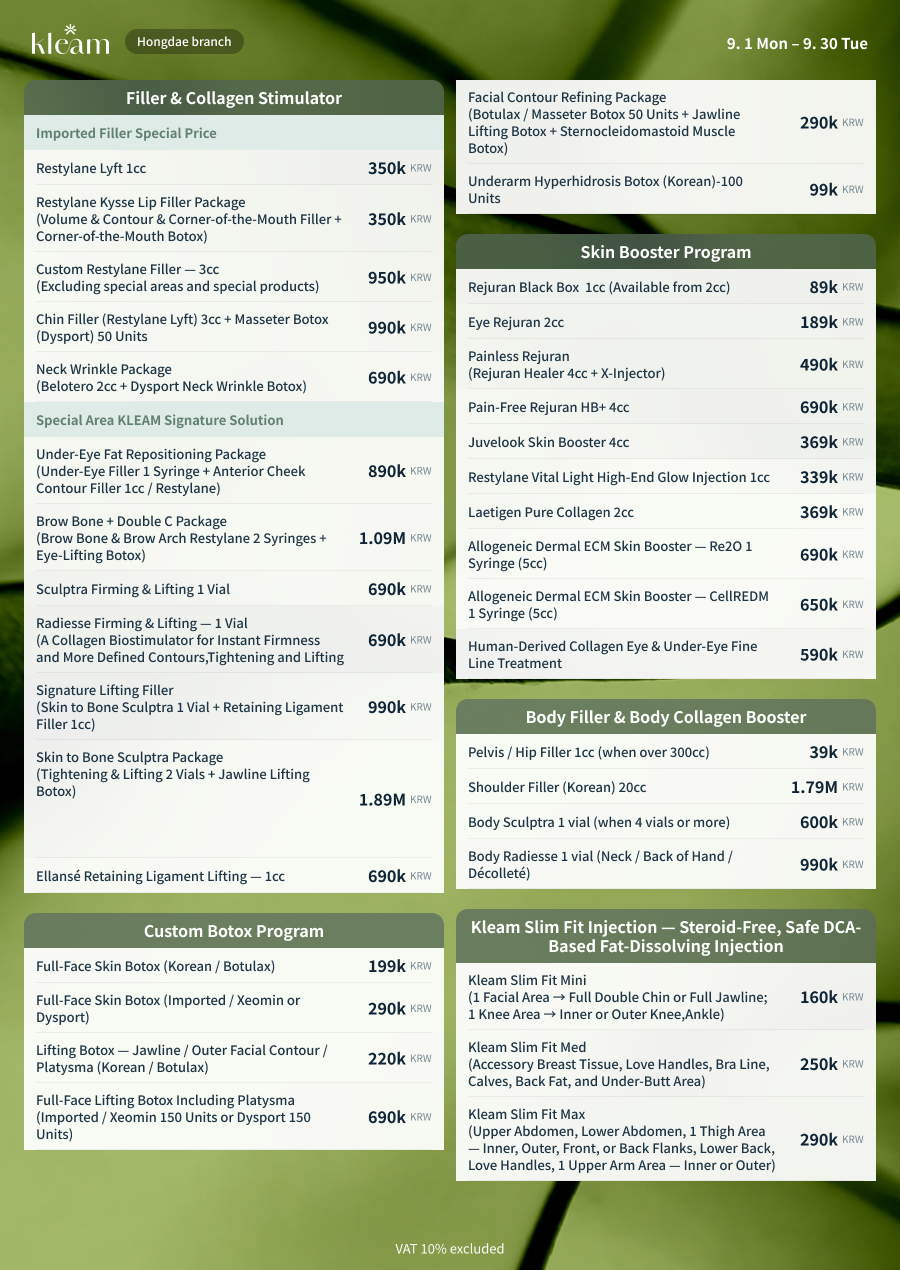
These are typical Seoul market ranges and vary by clinic. For what a clinic charges right now, see the current price list and ask about current promotions.
Why are imported fillers more expensive than Korean fillers?
Korea manufactures many of its own HA fillers, so local brands cost less to supply. Imported products such as Juvederm in Seoul and Restylane in Korea carry import and distribution costs, which is reflected in the per-cc price.
Price is not the only difference. Each product line comes in different firmness levels designed for specific areas: softer gels for lips and fine lines, firmer gels for chin, nose and cheekbones. Some foreigners choose an imported brand because they already know it from home and want a familiar product for future top-ups. Others choose a Korean filler to treat more areas within the same budget. Both are widely used in Seoul; your doctor can explain which suits your area and goals.
What about Radiesse and Sculptra?
Not every volumizing injection is an HA filler. Radiesse(calcium hydroxylapatite) and Sculptra(PLLA, typically KRW 500,000–1,000,000 or US$360–710 per vial) stimulate collagen and are priced differently, and they cannot be dissolved like HA. If you are weighing these options, read Sculptra vs Dermal Fillers.
How many cc of filler will you need?
The amount of filler is the biggest driver of your final bill. A rough guide for first-time patients in Korea:
- Lips: 0.5–1cc for a natural, hydrated look.
- Chin: 1–2cc for projection and a softer V-line.
- Nasolabial folds: often about 1cc per side, depending on depth.
- Temples or forehead: 1–2cc or more, as these areas take larger volumes.
- Under-eye (tear trough): small amounts of a soft filler, only if suitable.
For example, 2cc of a Korean filler in Seoul would typically total about KRW 200,000–500,000 (US$140–360), while 2cc of an imported filler would typically total about KRW 500,000–1,000,000 (US$360–710). A doctor decides the real amount after looking at your face; more is not always better.
What else affects filler prices in Seoul?
- Brand and product line: Korean vs imported, and which firmness of gel.
- Number of cc: some clinics price partial syringes for small areas, others sell whole syringes only.
- Doctor-performed injection: ask who injects and whether a cannula or needle is used.
- Genuine product: you can ask to see the sealed box or syringe label before treatment.
- VAT: 10% VAT is usually added to cosmetic procedures in Korea.
- Numbing and follow-up: check whether numbing cream, a touch-up check and aftercare are included.
Many patients combine filler with toxin, for example chin filler with jaw Botox. Reading Botox vs Filler helps you understand which concerns each one solves, so you only pay for what you need. For deeper lines, see the wrinkle treatment options in Seoul.
Is dermal filler in Korea worth it for foreigners?
For many visitors, yes: Seoul clinics offer a wide product choice, experienced injectors and per-cc pricing that is often lower than in many Western cities. The value comes from a careful plan rather than the lowest headline price.
Plan around downtime. Swelling and occasional bruising are common for 2–3 days, especially in the lips, so try to have filler early in your trip. If the result is not what you wanted, HA filler can be adjusted, and filler dissolving in Seoul is available, though it is a separate cost. Avoid filler if you are pregnant or breastfeeding, and tell the doctor about any past filler.
Planning your visit to a skin clinic in Hongdae, Seoul
Hongdae is easy to reach: Hongik Univ. Station is on Line 2, the Gyeongui–Jungang Line and the AREX Airport Railroad, which runs directly to Incheon and Gimpo airports. Leave a buffer of at least a day or two before your flight so any swelling or bruising can settle.
Ask whether English- or Japanese-speaking staff are available. Many clinics take consultations by WhatsApp or KakaoTalk, so send photos of the area and your travel dates in advance. Before booking, confirm who performs the injection, the exact product and cc, and whether 10% VAT is included. Read about dermal fillers in Hongdae and filler dissolving in Seoul, then compare quotes against the current Hongdae clinic price list.
Frequently asked questions
How much is 1cc of filler in Korea?
In Seoul in 2026, 1cc of Korean hyaluronic acid filler typically costs about KRW 100,000–250,000 (US$70–180). Imported fillers such as Juvederm, Restylane or Belotero typically cost about KRW 250,000–500,000 (US$180–360) per cc. Prices vary by clinic, product line and whether VAT is included, so always confirm the final amount before treatment.
Does dermal filler hurt?
Most people describe filler as mild to moderate discomfort. Clinics in Korea usually apply numbing cream for 20–30 minutes, and many fillers contain lidocaine, a local anesthetic. Lips tend to feel more sensitive than the chin or cheeks. The injection itself usually takes 10–30 minutes depending on how many areas are treated.
Can I fly after getting filler in Seoul?
Flying is generally possible after filler, but swelling and bruising are common for 2–3 days, especially in the lips. Many foreigners book filler early in their trip so any swelling settles and the doctor can check the result. Avoid pressing or massaging the area and skip saunas and intense exercise for the first couple of days.
How long does filler last?
Hyaluronic acid filler typically lasts about 6–18 months. Lips usually break down faster because they move a lot, while chin, nose and temple filler often lasts longer. Product type, the amount used and your metabolism also matter. Results vary, and many people choose a small top-up rather than repeating the full amount.
Can I combine filler with Botox or skin boosters?
Yes, filler is often combined with Botox on the same day, for example chin filler with jaw Botox for a V-line look. Combining with skin boosters or lasers is also common but depends on the areas involved. A doctor will decide the order and timing at consultation to keep swelling manageable and results predictable.
Related guides
This guide is general information for international visitors, not medical advice. A doctor confirms suitability, dosage and number of sessions at consultation. Prices are approximate Seoul market ranges and change over time — always check the clinic's current price list. Last updated: October 2026.