Rejuran vs Juvelook: Which Skin Booster Is Better?
Quick answer: Rejuran is better if your main goal is skin repair: calming sensitive, stressed or post-acne skin and refining texture with polynucleotides. Juvelook is better if you want firmer, thicker-feeling skin and softer fine lines, because its PDLLA stimulates new collagen. Many people in Seoul start with Rejuran for repair, then add Juvelook for structure.
What is the difference between Rejuran and Juvelook?
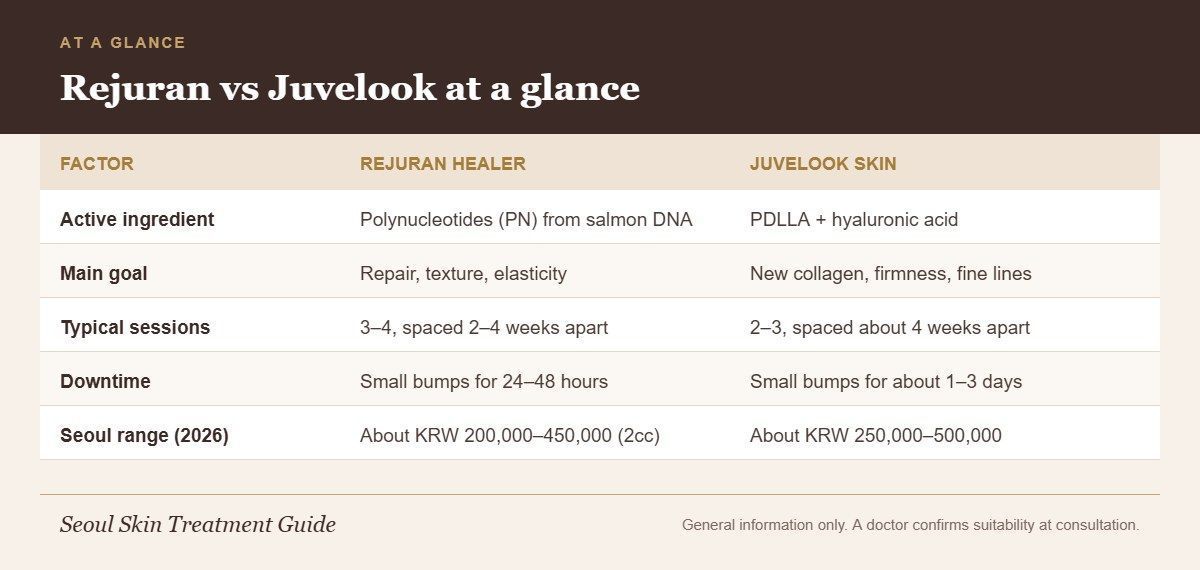
Rejuran Healer is an injectable skin booster made of polynucleotides (PN) derived from salmon DNA. In Korea it is used to support the skin’s own repair process, improve elasticity and refine rough texture, which is why it is often described as a “healing” booster.
Juvelook is a collagen-stimulating injectable that combines PDLLA (poly-D,L-lactic acid) with hyaluronic acid. The hyaluronic acid gives light hydration, while the PDLLA particles prompt your skin to produce new collagen over the following weeks. Juvelook Skin targets skin quality; Juvelook Volume contains more PDLLA and is used where you need a little volume.
A simple way to remember the difference in the Rejuran vs Juvelook question: Rejuran repairs the skin you have, while Juvelook builds more support underneath it. Both are commonly offered in a clinic’s skin booster menu in Seoul, and a doctor decides which one suits your skin at consultation.
| Factor | Rejuran Healer | Juvelook Skin |
|---|---|---|
| How it works | Polynucleotides support repair and the skin barrier | PDLLA stimulates new collagen; HA adds light hydration |
| Best for | Sensitive or stressed skin, dullness, uneven texture, early fine lines | Thin or crepey skin, loss of firmness, fine lines, shallow acne scars |
| Typical sessions | 3–4, every 2–4 weeks | 2–3, about every 4 weeks |
| When you notice change | Glow and texture often within a few weeks; builds over the series | Gradual firmness over weeks to months as collagen forms |
| Downtime | Small bumps 24–48 hours | Small bumps about 1–3 days |
| Typical Seoul range (2026) | About KRW 200,000–450,000 (2cc) | About KRW 250,000–500,000 per session |
Which skin booster is better for your skin concern?
The right choice depends less on which product is “stronger” and more on what your skin is missing. Think of your top one or two concerns, then match them below.
Choose Rejuran if your skin needs repair
- Your skin is easily irritated, red or reactive after peels, lasers or harsh products.
- You have dullness, rough texture or a tired look without much sagging.
- You want to calm skin after acne and improve overall skin condition.
- You are concerned about thin under-eye skin; eye Rejuran is a dedicated option for under-eye dark circles and crepiness.
Choose Juvelook if your skin needs structure
- Your skin feels thinner or less springy than it used to, especially from your mid-30s onward.
- You have fine lines on the cheeks or around the mouth that hydration alone does not soften.
- You have shallow, rolling acne scars and want a collagen-based option alongside other acne scar treatments in Seoul.
- You want a natural, gradual improvement rather than the instant fill of a filler.
If you have both concerns, that is common. Doctors in Korea often treat repair first, then collagen. You can read more about how PDLLA fits among other collagen stimulators before your consultation.
How long do Rejuran and Juvelook results take and last?
Rejuran results tend to show as a smoother, more even surface. Many people notice a healthier glow a couple of weeks after the first session, and the improvement becomes more consistent across a 3–4 session series. After that, many patients book maintenance sessions; your doctor will suggest a schedule based on your skin.
Juvelook works more slowly because the body has to build new collagen. Expect gradual firmness over the weeks and months after a 2–3 session series rather than an overnight change. Because the effect relies on your own collagen, results vary with age, skin thickness and lifestyle, including sun exposure and smoking.
Neither treatment replaces sun protection. Daily SPF protects the collagen and repair you are paying for, and results vary from person to person.
How much do Rejuran and Juvelook cost in Seoul?
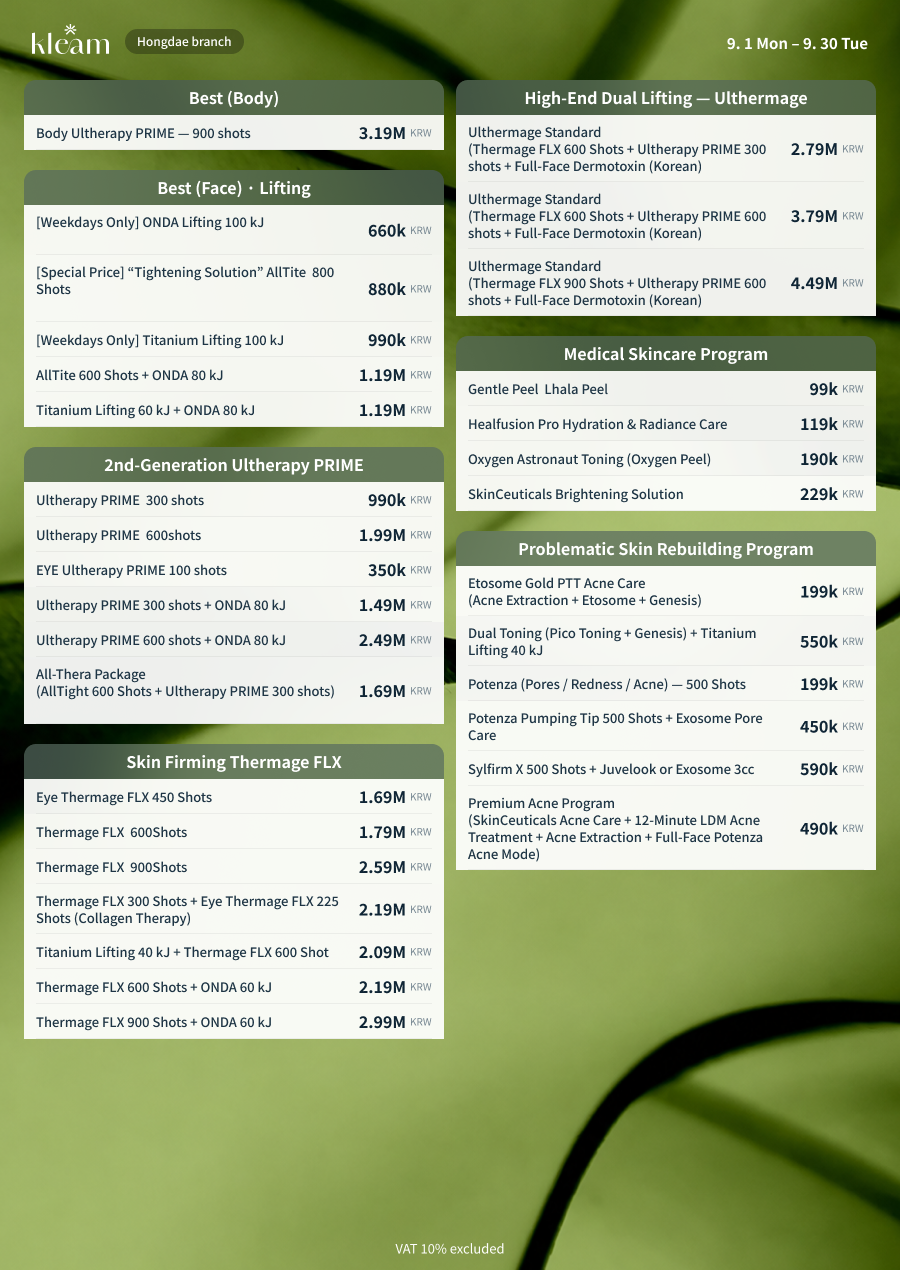
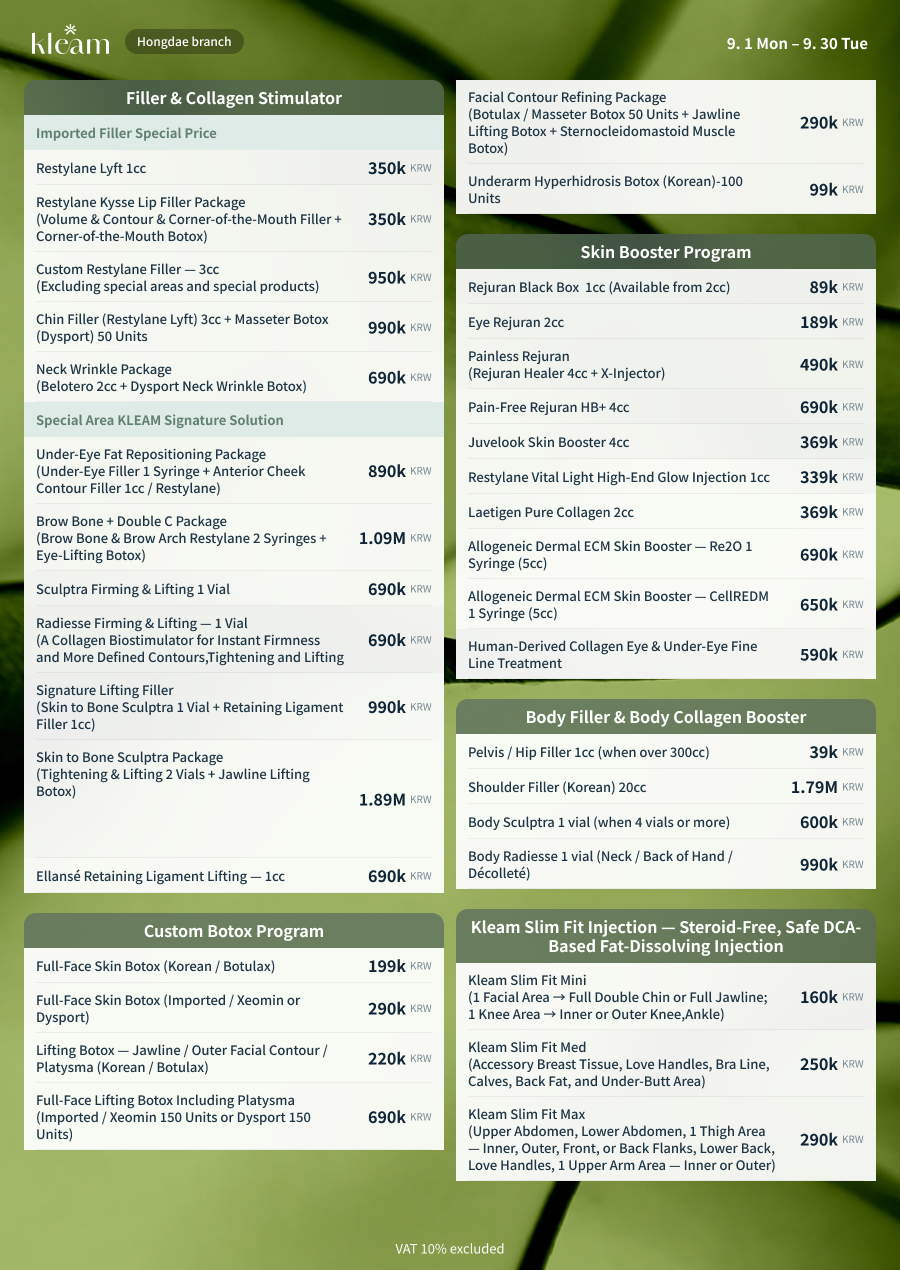
In Seoul, Rejuran Healer 2cc typically costs about KRW 200,000–450,000 (roughly US$140–320) per session in 2026. Juvelook Skin typically costs about KRW 250,000–500,000 (roughly US$180–360) per session, and Juvelook Volume about KRW 400,000–800,000 (roughly US$290–570). These are approximate market ranges, not any single clinic’s prices.
Because both are series treatments, budget for the full plan rather than one session:
- Rejuran series: 3 sessions at Seoul market rates is roughly KRW 600,000–1,350,000.
- Juvelook series: 2 sessions is roughly KRW 500,000–1,000,000.
What changes the price: the amount injected (cc), Rejuran Healer vs Rejuran HB (which contains lidocaine) or eye Rejuran, injection by hand vs with a device, whether numbing cream is included, package pricing for a series, and the 10% VAT usually added to cosmetic procedures. For current figures, check current price list, and see our detailed Rejuran cost guide for Korea and Juvelook cost guide for Korea.
Can you combine Rejuran and Juvelook?
Yes, combining them is common in Korea, but the plan should come from a doctor who has examined your skin. Typical approaches include:
- Repair first, then build: one or two Rejuran sessions to calm and strengthen the skin, followed by Juvelook.
- Alternating: Rejuran and Juvelook on separate visits several weeks apart.
- Booster plus device: pairing a booster with a laser or microneedling, where a doctor decides spacing.
If your skin is mainly recovering from lasers or irritation, also compare Rejuran with exosome in our guide to Rejuran vs Exosome for skin repair. For the full three-way picture, see Juvelook vs Rejuran vs Exosome.
Is Rejuran or Juvelook better for a short trip to Korea?
For a single visit, either works because downtime is short. Rejuran bumps usually settle in 24–48 hours, and Juvelook bumps in about 1–3 days. Avoid booking the day before a big event or photos, and leave at least a day before a long-haul flight if you can.
The bigger issue for foreigners is the series. Rejuran sessions are spaced 2–4 weeks apart, and Juvelook sessions about 4 weeks apart, so most short-trip visitors do one session per trip, or start in Seoul and continue at a clinic at home. Expats living in Seoul can complete the full series more easily. Tell the doctor your travel dates so the plan matches your schedule.
Planning your visit to a skin clinic in Hongdae, Seoul
Hongdae is convenient for short trips. Hongik Univ. Station is on Seoul Subway Line 2, the Gyeongui–Jungang Line and the AREX Airport Railroad, with direct trains to Incheon and Gimpo airports, which helps if you are fitting a booster in before or after a flight.
- Ask whether English- or Japanese-speaking staff are available.
- Many clinics take consultations by WhatsApp or KakaoTalk; send photos of your skin and your travel dates.
- Confirm who performs the treatment, the exact product and cc, and whether the 10% VAT is included in the quote.
- Check the clinic’s current Hongdae clinic price list before you book.
- Leave a buffer of at least a day before your flight.
Before booking, read about Rejuran Healer in Hongdae, Juvelook in Seoul and exosome treatments in Korea so you can ask informed questions at your consultation.
Frequently asked questions
Is Rejuran or Juvelook better for fine lines?
Juvelook is usually the better match for fine lines linked to thinning skin, because its PDLLA stimulates new collagen over several weeks. Rejuran can soften very early lines by improving elasticity and texture. If lines are deeper or caused by muscle movement, a doctor may suggest Botox or another treatment instead of, or alongside, a skin booster.
Does Rejuran or Juvelook hurt more?
Both involve many small injections, so most people describe a stinging or pressure sensation rather than sharp pain. Numbing cream is commonly applied first. Rejuran is known for being a little uncomfortable, which is why Rejuran HB with lidocaine exists. Your clinic can explain the comfort options available on the day of your session.
How many sessions of Rejuran or Juvelook do I need?
Rejuran is typically planned as 3–4 sessions spaced 2–4 weeks apart. Juvelook is typically 2–3 sessions about 4 weeks apart. Some people see a benefit after one session, but results build across the series. A doctor confirms the number of sessions after looking at your skin, age and goals.
Can I fly the day after Rejuran or Juvelook?
Usually yes, as long as you accept that small bumps may still be visible. Rejuran bumps typically fade within 24–48 hours and Juvelook bumps within about 1–3 days. Keep the skin clean, skip makeup on the first day if advised, avoid saunas and alcohol for a short period, and use sunscreen when you land.
Can I get Rejuran and Juvelook in Seoul with English support?
Yes. Many clinics in Seoul serve foreign patients, and many clinics in Hongdae offer English- and Japanese-friendly staff with consultations by WhatsApp or KakaoTalk. Send photos and your travel dates in advance so the clinic can suggest which skin booster and schedule fits your stay before you arrive.
Related guides
This guide is general information for international visitors, not medical advice. A doctor confirms suitability, dosage and number of sessions at consultation. Prices are approximate Seoul market ranges and change over time — always check the clinic's current price list. Last updated: October 2026.